

Last Updated: November 9, 2026
Quick Summary
The best high margin food products for resale in 2026 are shelf-stable, lightweight items like seasoned nuts, pretzels, dip mixes, dessert mixes, salsa mixes, guacamole mix, cracker seasoning, beer bread mixes, and specialty beverages. These products carry low unit costs and strong perceived value, so you can price them from $4.95 to $7.95 and still keep a healthy gross margin.
- Food retailers average a 2.1% net profit, so resellers need products with stronger margins.
- Rice cakes posted roughly 25% year-over-year dollar gains, with meat snacks up 13.1%.
- Calculate food cost percentage before committing to a case, not after.
- A $4.95 mix with a $2.50 landed cost yields a 49.5% gross margin.
- Set a reorder point at two weeks of average sales for shelf-stable dry mixes.
Table of Contents
- Why High Margin Food Products for Resale Beat Everything Else on Your Table
- The 9 Best High-Margin Food Products for Resale in 2026
- How to Calculate Food Product Profit Margin Before You Buy
- Shelf-Stable Food Products for Resale: Why They Win on Logistics
- High-Margin Products Wholesale: What to Ask Before You Sign
- Packaging and Perceived Value: The Margin Lever Most Sellers Ignore
- Scaling Your Resale Business Without Blowing Up Your Margins
- What to Ignore When Choosing Food Products to Resell
- Stocking Your First Case: What CherryOrchardFoods Sells and How to Order
- Frequently Asked Questions
Why High Margin Food Products for Resale Beat Everything Else on Your Table
Food retailers average a 2.1% net profit, according to FMI's food industry facts. That number explains why so many store owners and festival vendors hunt for high margin food products for resale instead of competing on cases of soda. At CherryOrchardFoods, we have spent more than 30 years in the restaurant and snack food business, and we have watched small-batch gourmet items outperform commodity groceries on nearly every shelf.
The Numbers Behind Food Resale Margins
Markup is the multiplier you apply to unit cost; margin is what you keep after the sale. A food manufacturer typically runs 30% to 35% margins, according to Find Homegrown's wholesale pricing guidance, while restaurant menu items can reach 60% to 75%, per Toast's menu profitability analysis. Resellers sit between those poles, and the gap comes down to shelf life, packaging, and how fast inventory turns.
The 9 Best High-Margin Food Products for Resale in 2026
The best high-margin food products for resale in 2026 are shelf-stable, lightweight, and easy to merchandise. Salty snacks are leading the category: rice cakes posted roughly 25% year-over-year dollar gains, with meat snacks up 13.1%, according to Penn State Extension's 2026 food trends report. Here are the nine categories we would stock first.
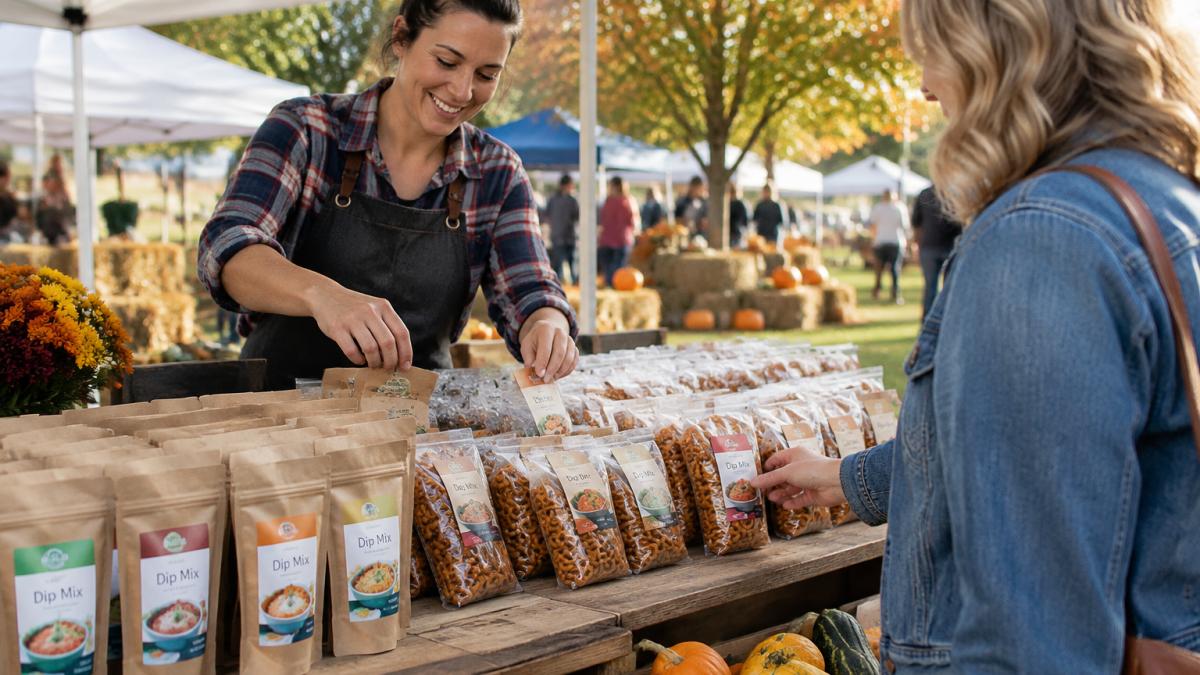
- Seasoned nuts and snack mixes. Small bags, high perceived value, long shelf life. Our Hand Crafted Premium Seasoned Peanuts retail at $5.99.
- Seasoned pretzels. Seven flavors, $4.95 retail, and they sell on impulse.
- Dip and spread mixes. A $4.95 pouch plus a block of cream cheese becomes a party item. Our Infused Party Spreads are blended with cream cheese.
- Dessert mixes. No-bake cheesecakes and cream pies, 21 flavors, $4.95.
- Salsa mixes. Add a can of tomatoes, $4.95.
- Guacamole mix. All-natural, no MSG, gluten free, $4.95.
- Cracker seasoning. Turns a $3 box of crackers into a giftable snack, $5.49.
- Beer bread mixes. Seven flavors, ready in under an hour, $7.95.
- Specialty beverages. Mulling spices and Russian tea, $5.49.
Quick Comparison: Cost, Markup, and Best Use
| Product | Retail Price | Best Use | Why It Sells |
|---|---|---|---|
| Seasoned Peanuts | $5.99 | Festival impulse buy | Six bold flavors, resealable |
| Seasoned Pretzels | $4.95 | Gift baskets | Seven flavors, low unit cost |
| Infused Party Spreads | $4.95 | Holiday entertaining | Wine powder, two flavors |
| No-bake Dessert Mixes | $4.95 | Bake sales, hostess gifts | 21 flavors, make-ahead |
| Salsa Mixes | $4.95 | Tasting tables | Mild to hot, seven options |
| Guacamole Mix | $4.95 | Taco nights | No preservatives, no MSG |
| Cracker Seasoning | $5.49 | Add-on sales | Two blends, high attach rate |
| Beer Bread Mixes | $7.95 | Soup-and-bread bundles | Seven flavors, under an hour |
| Specialty Beverages | $5.49 | Winter markets | Seasonal, gift-ready |
Retail Price


Best for: vendors who want a fast-turning table with low unit cost. Skip if: your customers only buy fresh produce.
How to Calculate Food Product Profit Margin Before You Buy
Food cost percentage is your unit cost divided by your selling price, expressed as a percentage. If a dip mix costs you $2.50 wholesale and you sell it at $6.00, your food cost is 41.7% and your gross margin is 58.3%. Run that math before you commit to a case, not after.
Here is the formula we recommend:
- Gross margin = (retail price − unit cost) ÷ retail price
- Break-even units = fixed costs ÷ (retail price − unit cost)
- Inventory turnover = units sold ÷ average units on hand
Subtract packaging, booth fees, and payment processing from gross margin to reach net profit. A product with a 60% gross margin can still lose money once you add a $75 booth fee and $30 in gas.
Shelf-Stable Food Products for Resale: Why They Win on Logistics
Shelf-stable food products for resale solve the problems that can hurt small resellers. Dry mixes are shelf-stable rather than perishable.
Our mixes come in zip-lock pouches, and we suggest placing unused portions in an airtight container to help keep them fresh.
High-Margin Products Wholesale: What to Ask Before You Sign
High-margin products wholesale only stay high-margin when the terms support you. Ask these questions in writing before you sign, and get the answers in the contract, not in a phone call.
Niche market saturation matters here too. If three vendors at your market already carry the same brand, your margin compresses fast. Before you sign, walk the market and count facings. Differentiate on flavors and presentation, or negotiate an exclusive for your ZIP code; some small suppliers will grant a informal territory courtesy for a committed opening order, and it costs you nothing to ask.
You can review our Wholesale Program to see the two program structures we offer for dip mixes.
Packaging and Perceived Value: The Margin Lever Most Sellers Ignore
Packaging costs are the quiet margin killer, but they are also the cheapest price increase you can buy. A resealable pouch with a clean label reads as a gift; a plain bag reads as a commodity. The same $4.95 mix can sell at $6.00 in a basket with a ribbon.
All spice and herb ingredients are measured and double checked by hand, with no machines involved in that step. That is the kind of detail worth putting on a shelf card.
Best for: vendors with a display table. Skip if: you sell only online, where photography carries that job instead.
Scaling Your Resale Business Without Blowing Up Your Margins
Scaling breaks more resellers than starting does. As you add product lines, supply chain management gets more complicated and customer relationships get harder to manage, according to research in the University of San Francisco repository. The fix is not to grow slower; it is to grow on unit economics you can see before you commit cash.
Run the Unit Economics Before You Add a Channel
Every channel has a break-even you can calculate in a spreadsheet. Take a $4.95 mix with a $2.50 landed unit cost. Gross margin is $2.45 per unit, or 49.5%. Now layer the channel:
- Festival booth: $300 booth fee + $30 gas + $75 in display and bags = $405 fixed. Break-even is 166 units. At 400 units sold you clear $575 before your own labor.
- Farmers market stall: $40 weekly fee + $20 fuel = $60 fixed. Break-even is 25 units. The margin per unit is lower because you cap volume, but the downside is small.
- Online storefront: payment processing at roughly 2.9% + $0.30 per transaction plus shipping. On a $4.95 single-unit order, processing alone eats about 9% of the sale, so set a free-shipping threshold that pushes average order value to three or more units.
A common pattern is that resellers scale the channel with the best gross margin per unit and discover it has the worst net margin after fixed costs. Track contribution margin per channel, not per product, and retire any channel that does not clear its fixed costs within two cycles.
Manage Perishable and Shelf-Stable Inventory Differently
Shelf-stable dry mixes turn slowly without spoiling; perishables turn fast or die. That difference should drive your reorder logic:
- Shelf-stable (dry mixes, seasoned nuts, pretzels): set a reorder point at two weeks of average sales and a safety stock of one week. Inventory turnover of four to six times a year is healthy for a small vendor. Cash tied up here is cheap because the product does not expire.
- Perishable (fresh dips, baked goods, refrigerated items): order to a forecast, not to a minimum. Track sell-through daily for the first two weeks of any new perishable, then set order quantity at 80% of the trailing average so you spoil on the slow day, not the fast one. A dropped pouch of dry mix is a minor loss; a case of spoiled fresh dip is a total one.
Watch out: buying perishable inventory before you have tested foot traffic can leave you with spoilage you cannot recover, and the loss lands in the same month as your booth fees.
Add One Category at a Time, and Prove It First
Add a category only when the current one has cleared its fixed costs for two consecutive cycles and you have cash on hand to cover the new minimum order without touching operating cash. A practical test: if the new line does not sell through 70% of its opening order within 60 days, do not reorder at the same volume. Track customer acquisition cost against recurring revenue. A festival booth that costs $300 and returns $900 is worth repeating; one that returns $350 is a hobby. If you want to grow with a family-owned supplier, our Business Opportunity page explains how partners work with us.
What to Ignore When Choosing Food Products to Resell
Ignore the loudest trend on social media and ignore anyone who promises a margin without naming a unit cost. Plant-based meat and seafood sat at roughly $1.0 billion in retail sales while dollar sales fell 10% in 2025, according to the Good Food Institute's retail market overview. Category size is not the same as category profit.
Ignore private label envy, too. Building your own brand takes capital most small sellers do not have. Start by reselling proven items, then expand.
Stocking Your First Case: What CherryOrchardFoods Sells and How to Order
We make every mix by hand in small batches, with no added preservatives and no artificial colorings or flavorings. Before you order for a party, check the allergen alerts on the label and confirm whether a mix is savory or spicy. Many home cooks get disappointing results simply because they skip the mixing instructions.
Our Collections page lists over 200 hand-crafted gourmet food mixes, and Wholesale Orders walks you through the ordering process. New to reselling? Grab our free mini eBook to start your own business.

The margin math is unforgiving, but the fix is simple: stock shelf-stable, hand-crafted items with a story, price them with the formula above, and test one category before you scale. CherryOrchardFoods makes that first case easy with over 200 hand-crafted mixes, small-batch production, and resealable zip-lock pouches that protect flavor to the last serving. Get started with CherryOrchardFoods and build a table that turns a profit from the first market.
Frequently Asked Questions
What are the highest-margin food products to sell?
Dry mixes and seasoned snacks carry some of the strongest margins because they cost little to make, weigh little to ship, and do not spoil. A dessert or salsa mix priced at $4.95 with a unit cost near $2 leaves roughly 60% gross margin. Seasoned peanuts at $5.99 and pretzels at $4.95 follow the same pattern. Compare that to food retailers averaging 2.1% net profit, per FMI's 2025 data, and the gap is obvious.
How do I calculate food product profit margin?
Subtract your total unit cost from your selling price, then divide by the selling price. If a beer bread mix costs you $4.00 landed and sells for $7.95, your gross margin is $3.95, or about 50%. Include packaging, labels, and shipping in the cost, not just the wholesale price. Track this per product every quarter, because bulk purchasing and shipping changes shift the number faster than most sellers expect.
Which food products are best for small retailers to resell?
Look for shelf-stable items with a clear use occasion and a price under $10. Dip mixes, cracker seasoning, dessert mixes, and seasoned nuts all fit. They resist heat and handling at markets, need no refrigeration, and stack in small spaces. CherryOrchardFoods sells these as hand-crafted, small-batch products in zip-lock pouches, which also helps with storage between events.
Where can retailers find high-margin wholesale food products?
Start with small-batch producers who sell direct to retailers rather than through distributors, since you skip a layer of markup. Ask for a wholesale price sheet, minimum order quantities, and case dimensions before committing. CherryOrchardFoods offers wholesale partnerships alongside its retail line of over 200 gourmet mixes, which lets a boutique or resort test a few flavors before placing a larger seasonal order.
What should I consider before reselling food products?
Check three things: shelf life and storage conditions, allergen labeling, and whether the product needs any licensing where you sell. Read the allergen alerts on every label, since party and gift buyers ask often. Confirm the margin holds after packaging and shipping. Then test a small order at one event before buying cases, so you learn which flavors sell before your cash is tied up in inventory.
